

PUBLICATIONS
Journal Articles
Enhanced rock weathering has greater promise as a sustainable farming practice than a CO2 removal technology
JONATHAN SPENCE • SASHA WILSON
PROJECT RESEARCH AREA - ACTIVITY 6
-
Concrete accounts for approximately 7% of global anthropogenic CO emissions, nearly two-thirds of which are hard-to-abate limestone calcination emissions that are partially offset through natural carbonation. This study presents a dynamic cradle-to-grave carbon footprint assessment of six scenarios for hollow concrete blocks, evaluating carbon capture, carbonation curing and mineral carbonation alongside their impact on natural CO uptake. Natural carbonation offsets – of calcination emissions, rising to –, depending on modelling assumptions, with carbonation curing. Static accounting overestimates this benefit by –. Compared with conventional concrete, carbon capture, utilization, and storage scenarios can reduce emissions by –, with carbon capture responsible for – and the elimination of steam curing for –. Subsequent carbonation curing and mineral carbonation components themselves yield only marginal emission savings of –, but reduce the reliance on geological CO storage by – relative to a capture-only scenario. These findings show that carbon capture and eliminating steam curing drive the emission reductions, while carbonation curing and mineral carbonation offer alternatives to CO storage.
JUNE 2026
-
Carbon dioxide removal (CDR) is likely to be part of any credible plan to meaningfully address climate change. To be effective, such strategies must maximize net greenhouse gas reductions while efficiently using energy, land, materials, and financial resources. One relatively inexpensive way to remove CO2 from the atmosphere is enhanced rock weathering (ERW)—the spreading of crushed alkaline silicate rocks on agricultural land to accelerate natural weathering. Compared with many other CDR strategies, ERW offers lower capital requirements and a clearer path to large-scale deployment. Crucially, it can be readily integrated into existing agricultural practices by replacing the agricultural lime (aglime) that farmers worldwide use to reduce soil acidity. As a result, ERW has attracted considerable attention and investment.
Dynamic carbon footprint trade-off between carbonation curing, mineral carbonation and natural carbon uptake in concrete blocks
AUGUST 2026
MAZIAR JAVADPOUR • SEAN MCCOY • SYLVIA SLEEP
PROJECT RESEARCH AREA - ACTIVITY 6
Reports
Exploring Canada’s Carbon Removal Future: A Symposium Hosted by CanCO2Re
FEBRUARY 2026
LUISA CORREDOR • MARGRET NELLISSERY
PROJECT RESEARCH AREA - ACTIVITY 15
Getting CDR right the first time: Exploring potential impacts through interdisciplinary workshops
NOVEMBER 2025
LUISA CORREDOR • MARGRET NELLISSERY
PROJECT RESEARCH AREA - ACTIVITY 15
Other Publications
Fossil Fueling Neoliberalism: Notes on the Oilmen’s Market Crusade
OCTOBER 2025
Canada Needs a Resource Strategy for Carbon Management
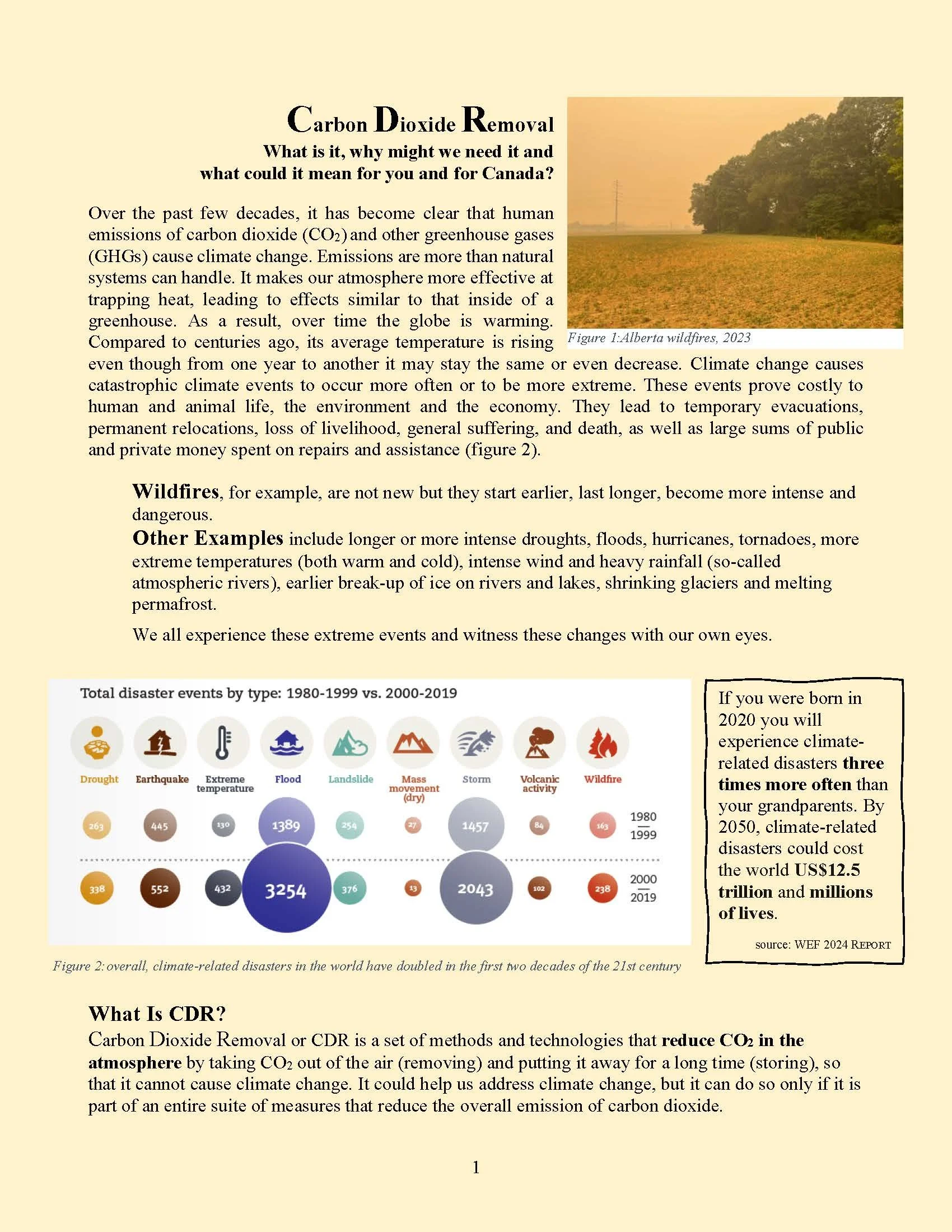
Carbon Dioxide Removal (CDR): What is it, why might we need it and what could it mean for you and for Canada?
COP Out: Technology, Rhetoric, and Climate Crisis
MAY 2025
MAY 2025
PROJECT RESEARCH AREA - ACTIVITY 5 AND TASK 2
JANUARY 2025